What Is the Darkest Legal Tint in NJ? 2026 Guide
What is the darkest legal tint in New Jersey? Learn which windows can be tinted, where 5% limo tint can be used, front-window restrictions, rear-window rules, medical exemptions, and what NJ drivers should know.

What Is the Darkest Legal Tint in NJ? 2026 Guide
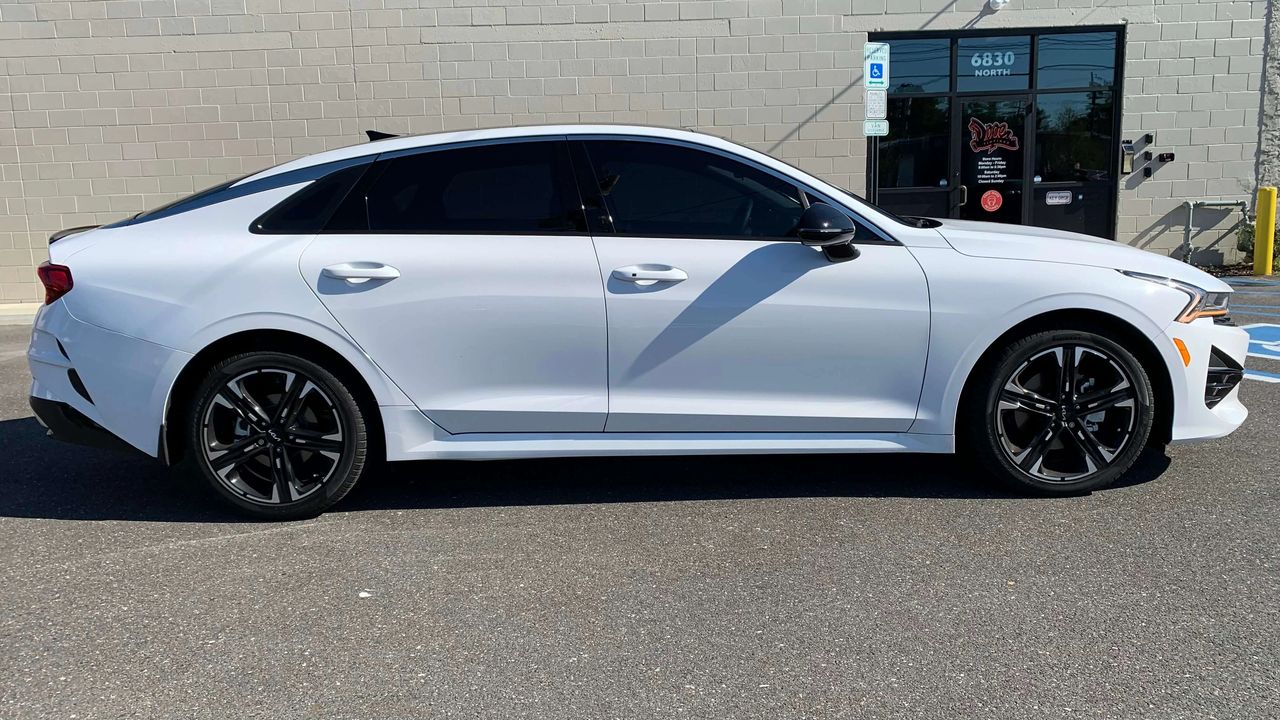
In New Jersey, the darkest legal aftermarket tint depends on which window you're talking about. For most drivers without an approved medical exemption, aftermarket tint is not permitted on the front side windows or main windshield. Windows behind the driver can be tinted much darker, including 5% limo tint. Rear-window visibility and exterior-mirror requirements can also apply depending on how much the driver's rearward view is obstructed.**
If you're searching for one number such as:
35%
20%
or
5%
to describe the darkest legal tint for an entire vehicle in New Jersey, that's where the confusion starts.
New Jersey doesn't treat every window the same.
Here's the basic breakdown:
| Window | General New Jersey Rule |
|---|---|
| Main windshield | Aftermarket sunscreening is restricted for most drivers without an approved medical exemption |
| Front driver window | Aftermarket sunscreening is restricted for most drivers without an approved medical exemption |
| Front passenger window | Aftermarket sunscreening is restricted for most drivers without an approved medical exemption |
| Rear side windows | Very dark tint, including 5% limo tint, can be used |
| Rear window | Very dark tint can be used; exterior-mirror/rear-visibility requirements can apply |
At Dope Tintings in Pennsauken, NJ, we've been tinting vehicles for more than 20 years and have completed more than 30,000 automotive window tint installations.
One of the biggest misconceptions we hear is:
"I thought 35% was the legal tint in New Jersey."
That's not a useful way to understand the law.
The first question should always be:
Which window are you talking about?
For the complete statewide breakdown, read New Jersey Window Tint Laws: Complete 2026 Guide.
Can You Legally Have 5% Tint in New Jersey?
Yes, 5% limo tint can be used on eligible glass behind the driver in New Jersey.
That does not mean 5% is permitted on every window.
This is the distinction that gets lost when people say:
"5% tint is legal in NJ."
or:
"5% tint is illegal in NJ."
Both statements are incomplete without identifying the window.
5% on a rear side window is a different legal question from 5% on the front driver window.

So if you want a very dark rear setup, 5% can be an option.
If you're asking about the windshield or front side windows, different restrictions apply.
Can Rear Side Windows Be Any Darkness in New Jersey?
Windows behind the driver have substantially more flexibility than the windshield and front side windows.
That means customers can choose extremely dark rear-window setups.
Common rear percentages we install include:
- 35%
- 20%
- 15%
- 5%
- Extremely dark options such as 1%
The percentage you choose for eligible rear glass should depend on more than legality.
You should also think about:
- Privacy
- Appearance
- Nighttime visibility
- Whether children ride in the rear
- Whether you regularly drive on poorly lit roads
Just because you can go extremely dark doesn't mean you have to.
Can the Rear Window Be 5% in New Jersey?
Very dark tint can be used on the rear window, but the driver's rearward visibility and exterior mirrors matter.
If the rear glass becomes dark enough to obstruct the driver's view through it, exterior mirrors become important for maintaining the required rearward view.
Most modern vehicles already have exterior mirrors on both sides.
Still, this is why a complete explanation is better than simply saying:
"Anything goes on the back window."
The rear glass is treated very differently from the main windshield and front side windows, but applicable vehicle-equipment requirements still matter.
Is 1% Tint Legal in New Jersey?
On eligible glass behind the driver, extremely dark film such as 1% can be an option.
But 1% is substantially darker than 5%.
It allows very little visible light through and can make nighttime visibility extremely difficult.
We carry extremely dark film because some customers specifically want maximum privacy.
That doesn't mean we recommend 1% to the average driver.
For most customers considering a dark rear setup, 5%, 15% or 20% provides more practical choices.
Are Tinted Front Windows Legal in New Jersey?
For most drivers without an approved medical exemption, aftermarket sunscreening on the front driver and passenger side windows is restricted.

This is where customers often get confused.
They see vehicles everywhere with:
- 35% front tint
- 20% front tint
- 15% front tint
- 5% front tint
and assume:
"There are too many cars with tinted fronts for it to be illegal."
What people choose to drive with and what New Jersey permits are two different questions.
A shop carrying a particular percentage also doesn't automatically make that percentage legal on every window.
Is 35% Tint Legal on the Front Windows in NJ?
Don't treat 35% as New Jersey's universal legal front-window percentage.
This is probably the most common tint-law misconception we hear.
Customers regularly tell us:
"I thought 35% was legal on the two fronts."
But using a lighter aftermarket film doesn't automatically turn a restricted front-window installation into an ordinary legal configuration.
We've also had customers tell us they were stopped with relatively light front-window film.
That doesn't mean every driver with 35% will be stopped.
It means:
"It's light enough that police can see me"
should not be confused with:
"This is New Jersey's legal tint percentage."
What About 50% or Very Light Front Tint?
The same principle applies.
A very light film can be much less visually obvious than 5%, 15% or 20%.
But if your question is strictly:
"What should I do if I want to follow New Jersey's normal front-window rules?"
the answer isn't simply:
"Choose a lighter aftermarket percentage."
If minimizing tint-related legal concerns is your priority and you don't have an applicable approved exemption, leaving the front glass without aftermarket sunscreening is the cleanest approach.

Can You Tint the Windshield in New Jersey?
For most drivers without an approved medical exemption, don't treat a fully tinted aftermarket windshield as a normal legal installation.
The windshield is also the most important piece of glass for driver visibility.
Even apart from legality, extremely dark windshield tint can create serious visibility tradeoffs:
- At night
- During rain
- On roads without streetlights
- During bad weather
- In poorly illuminated areas
We've had customers choose dark windshield film because they liked the appearance and later discover that nighttime driving was much harder than they expected.
Is Ceramic Windshield Tint More Legal Than Regular Tint?
No.
Ceramic describes film technology.
It doesn't create a special legal exemption.
Ceramic film can provide excellent heat-rejection performance, but the word ceramic doesn't change New Jersey's rules about where aftermarket sunscreening can be used.
The same applies to carbon film.
Choose ceramic because you want its performance characteristics—not because someone told you ceramic tint receives different legal treatment.
Does New Jersey Have a Medical Tint Exemption?
Yes.
New Jersey has a medical sunscreening process for qualifying individuals with certain photosensitive medical conditions.
This can allow approved sunscreening on the windshield and/or front side windows that would otherwise be restricted.
But a medical exemption isn't simply:
"My doctor told me I need tint."
There is an NJMVC approval process.
The approved sunscreening must also meet the applicable state specifications.
How Dark Can Medical Tint Be in New Jersey?
New Jersey's medical-sunscreening rules establish specific standards rather than giving the customer permission to choose any darkness.
For approved medical sunscreening, the windshield and front side windows have their own light-transmission and reflectance requirements.
That means a medical exemption should not be interpreted as:
"I can legally put 5% on my windshield and front doors."
If you qualify medically, follow the current NJMVC approval process and the specifications associated with the exemption.

Does a Doctor's Note Automatically Make Tint Legal?
No.
A doctor's recommendation and an approved NJMVC medical-sunscreening exemption are not the same thing.
If you need sunscreening for a qualifying medical condition, complete the state process and keep the applicable documentation with the vehicle.
At Dope Tintings, if someone is requesting an installation based on a medical exemption, we want the appropriate approval/documentation rather than relying solely on a verbal explanation.
Does a Tint Shop Installing Dark Tint Mean It's Legal?
No.
This is another misconception worth clearing up.
There are two different questions:
What can physically be installed?
and:
What does New Jersey permit on that particular window?
A tint shop's willingness to install a percentage does not automatically establish that the configuration is legal for normal road use.
At Dope Tintings, we'd rather explain the distinction and let the customer make an informed decision.
What Does Legal Tint Actually Look Like on a New Jersey Vehicle?
This is something most legal charts don't show you.
That's why we've started building real-vehicle visual guides.
For a four-door passenger car, see What Does Legal Window Tint Look Like on a Sedan in New Jersey?.
That guide uses an actual customer 2017 Alfa Romeo Giulia to show the visual difference between untreated front glass and very dark rear tint.
For SUVs and crossovers, see What Does Legal Window Tint Look Like on an SUV in New Jersey?.
That guide uses a 2025 Jeep Grand Cherokee to show the common factory light-front/dark-rear configuration and explain factory privacy glass.
Those guides answer a different question from this article:
This page tells you how dark you can legally go.
The visual guides show you what those configurations actually look like on real vehicles.
Is the Darkest Legal Tint Always the Best Tint?
No.
Legal darkness and practical darkness are different questions.

A customer may be able to use an extremely dark film on eligible rear glass and still decide that 1% or 5% is too dark for how they drive.
Before choosing the darkest available rear film, think about:
- How often you drive at night
- Whether your roads are well lit
- Backing up
- Parallel parking
- Heavy rain
- Privacy
- Appearance
For many daily drivers, 15% or 20% provides a better balance than going as dark as possible.
That brings us to the practical difference between the most common percentages.
How Do 5%, 15%, 20% and 35% Tint Compare?
Once you understand which windows can be tinted, the next question is usually:
"How dark should I actually go?"
Here's a simple comparison of four percentages customers commonly ask us about:
| Tint Percentage | General Appearance | Privacy | Nighttime Visibility |
|---|---|---|---|
| 35% | Light | Low to moderate | Easiest of these four |
| 20% | Medium-dark | Good | Good balance for many drivers |
| 15% | Dark | More privacy | Darker than 20% at night |
| 5% | Very dark/limo tint | Very high | Can be difficult at night |
These are practical appearance and visibility observations—not a statement that each percentage is permitted on every window.
For eligible rear glass, the customer can choose the darkness based on what they're trying to accomplish.
Is 5% Tint Too Dark for a Daily Driver?
It depends on the driver.
Some of our customers have used 5% for years and know exactly what to expect.
Other customers choose 5% for the first time because they love the privacy and appearance, then discover that nighttime visibility is more difficult than they expected.
5% becomes especially challenging:
- On roads without streetlights
- During heavy rain
- While backing up
- While parallel parking
- In dark parking lots
If you've never driven with 5%, don't choose it solely because you like how it looks from outside.
Is 15% or 20% Better for Everyday Driving?
For many customers, 15% and 20% are the middle ground between 35% and 5%.
20% allows more visible light through and is generally easier to see through at night.
15% gives you a darker appearance and additional privacy.
At Dope Tintings, 20% is often the safer recommendation for someone who wants dark windows but is concerned about nighttime visibility.
Someone wanting a little more privacy may prefer 15%.
Neither percentage needs to be chosen simply because it's the darkest option available.
Does Interior Color Change How Dark Tint Looks?

Yes.
This is one reason two vehicles with the exact same tint percentage can look completely different in photographs.
A vehicle with a black interior can make the tint appear darker from outside.
A vehicle with a tan, beige or light-gray interior can make the same percentage appear lighter.
Other factors include:
- Sun direction
- Cloud cover
- Time of day
- Viewing angle
- Windshield light
- Sunroof or panoramic-roof light
That's why we recommend using photographs as a guide rather than assuming:
"If I get 20%, my car will look exactly like that other 20% vehicle."
The meter reading and the visual appearance aren't always perceived the same way.
Does Windshield Light Make Front Windows Look Lighter?
Yes.
An untreated windshield allows a large amount of light into the front of the cabin.
That light illuminates the:
- Driver
- Passenger
- Dashboard
- Front seats
From outside, the front side windows can therefore appear lighter than the rear portion of the vehicle.
This is something customers occasionally notice when picking up their vehicle.
They may have ordered the same darkness on multiple side windows and still feel like the fronts look lighter.
Nothing necessarily went wrong with the installation.
You may simply be seeing more interior light entering through the windshield.
Is Factory Privacy Glass the Same as Aftermarket Tint?
No.
Factory privacy glass and aftermarket window film are different products.
Factory privacy glass gets its darker appearance from the glass itself.
Aftermarket tint is a film installed onto the glass.
This distinction is particularly important on:
- SUVs
- Crossovers
- Pickup trucks
- Vans
Many of these vehicles already have dark factory glass behind the driver while the front doors remain clear-looking.

That factory appearance is one reason SUV owners frequently ask tint shops to make their two front windows match the rear.
For a real visual example, read What Does Legal Window Tint Look Like on an SUV in New Jersey?.
Can You Add Window Tint Over Factory Privacy Glass?
Yes.
Aftermarket film can be installed over factory privacy glass.
Customers do this for reasons such as:
- Additional privacy
- Darker appearance
- UV protection based on the film's specifications
- Better heat rejection
- Protecting children riding in the rear
The finished darkness depends on both the factory glass and the aftermarket film.
For example, factory privacy glass may already measure somewhere around the low-20% range on certain vehicles.
Adding another film over it can make the finished glass considerably darker.
That's why we meter the actual vehicle rather than assuming all factory privacy glass is exactly the same.
Does Darker Tint Block More Heat?
Not necessarily.
Darkness and heat rejection are two different characteristics.
A very dark basic film can provide less heat rejection than a lighter high-performance film.
That's why customers concerned primarily about heat shouldn't automatically say:
"Give me the darkest tint you have."
At Dope Tintings, we first determine what you want the film to accomplish.
Then we discuss the appropriate film technology and darkness.
For a detailed comparison, read What Is the Difference Between Carbon and Ceramic Window Tint?.
Does Ceramic Tint Change How Dark You Can Legally Go?
No.
Ceramic describes the film technology.
It does not change New Jersey's rules about where aftermarket sunscreening can be installed.
A 5% ceramic film is still approximately a 5% darkness category.
A 20% ceramic film is still approximately a 20% darkness category.
Ceramic is chosen primarily for its performance—especially heat rejection—not because it creates a different legal darkness limit.

Frequently Asked Questions About the Darkest Legal Tint in NJ
What is the darkest legal tint in NJ?
The darkest legal tint in New Jersey depends on the window. For most drivers without an approved medical exemption, aftermarket sunscreening is restricted on the front side windows and main windshield. Eligible glass behind the driver can be tinted very dark, including 5% limo tint, with applicable rear-visibility and exterior-mirror requirements considered.
Is 5% tint legal in New Jersey?
5% can be used on eligible glass behind the driver. That does not mean 5% is permitted on the front side windows or main windshield.
Can rear windows be any darkness in NJ?
Eligible windows behind the driver can be extremely dark. Rear-window visibility and applicable exterior-mirror requirements should still be considered.
Is 35% tint legal on the front windows in New Jersey?
Don't treat 35% as New Jersey's universal legal front-window percentage. For most drivers without an approved medical exemption, aftermarket sunscreening on the front side windows is restricted.
Is 20% tint legal in NJ?
20% can be used on eligible rear glass. The percentage alone does not determine legality; the window location matters.
Is 15% tint legal in New Jersey?
15% can be used on eligible rear glass. It should not be treated as a universal legal percentage for every window.
Is 1% tint legal in NJ?
Extremely dark film such as 1% can be an option on eligible glass behind the driver. It is much darker than 5% and can create significant nighttime-visibility limitations.
Does New Jersey allow medical tint exemptions?
Yes.
New Jersey has a medical-sunscreening process for qualifying individuals. Drivers must follow the applicable NJMVC approval process and the specifications associated with the exemption.
Is factory privacy glass the same as window tint?
No. Factory privacy glass gets its darkness from the glass itself, while aftermarket tint is a film applied to the glass.
Is 5% tint hard to see through at night?
It can be. 5% provides substantial privacy but can make nighttime visibility difficult, especially on poorly lit roads, during rain and while parking.
What Tint Would We Recommend for the Average New Jersey Driver?
The answer depends on which glass you're tinting and what you want the film to accomplish.
For eligible rear glass, if a customer says:
"I want privacy, but I don't want the vehicle ridiculously dark,"
20% is often one of our first recommendations.

It provides a noticeably tinted appearance while remaining easier to see through at night than 5%.
Customers wanting more privacy may prefer 15%.
Customers specifically wanting maximum privacy often choose 5%.
Customers prioritizing easier nighttime visibility may prefer 35%.
There isn't one percentage that's best for everybody.
Darkest Legal Window Tint in Pennsauken and South Jersey
Dope Tintings is located in Pennsauken, New Jersey, and we've been tinting vehicles for more than 20 years.
We regularly work with customers from:
- Pennsauken
- Camden
- Cherry Hill
- Maple Shade
- Cinnaminson
- Delran
- Collingswood
- Haddonfield
- Marlton
- Mount Laurel
- Moorestown
- Surrounding South Jersey communities
One of the most common questions customers ask us is:
"What's the darkest legal tint I can get?"
Our first question is:
"Which windows are you talking about?"
That's because there isn't one percentage that answers the question for the entire vehicle.
If your priority is staying within New Jersey's normal front-window rules, tell us that.
If your priority is maximum rear privacy, tell us that.
If nighttime visibility matters more than maximum darkness, tell us that.
We'd rather understand what you're trying to accomplish before recommending a percentage.
Final Answer: What Is the Darkest Legal Tint in NJ?
In New Jersey, the darkest legal aftermarket tint depends on which window you're talking about. For most drivers without an approved medical exemption, aftermarket sunscreening is restricted on the front side windows and main windshield. Eligible rear side windows can be tinted extremely dark, including 5% limo tint. The rear window can also be very dark, with applicable rear-visibility and exterior-mirror requirements considered.
Here's the short version:
| Window | General New Jersey Rule |
|---|---|
| Main windshield | Aftermarket sunscreening restricted for most drivers without an approved medical exemption |
| Front driver window | Aftermarket sunscreening restricted for most drivers without an approved medical exemption |
| Front passenger window | Aftermarket sunscreening restricted for most drivers without an approved medical exemption |
| Rear side windows | Very dark tint, including 5%, can be used |
| Rear window | Very dark tint can be used; rear-visibility/exterior-mirror requirements can apply |
So if you're asking:
"What's the darkest legal tint in New Jersey?"
don't look for one number that applies to the entire vehicle.
Instead, remember:
Front glass and rear glass are treated differently.
And even where extremely dark rear tint can be used, the darkest available percentage isn't automatically the best percentage for your driving habits.
For the complete statewide rules, read New Jersey Window Tint Laws: Complete 2026 Guide.
To see what this looks like on an actual four-door car, read What Does Legal Window Tint Look Like on a Sedan in New Jersey?.
To see the SUV/factory-privacy-glass version, read What Does Legal Window Tint Look Like on an SUV in New Jersey?.
For police-enforcement questions, read Can Cops Pull You Over for Just Window Tint in New Jersey?.
Dope Tintings
6830 N Crescent Blvd
Pennsauken NJ 08110
856-577-4119